Rana Matar
Determination is an invaluable trait, a fact known very well by Rana Matar, a 22-year-old director who has built quite an impressive resume by proving the significance of her work through protecting and honoring her creative voice, a way of being that she first formulated while pursuing a bachelor’s degree in filmmaking.
Imagine it’s your first year of college. You’re the youngest on campus, studying an emerging industry comprised of creative and technical competition. Rana puts it this way: “When you’re in film school, you always want to defend yourself, defend your style, defend your voice, defend what you’re trying to do.” The desire to be heard as an aspiring filmmaker is accompanied by pressure. Rana recalls hearing “that I wasn’t a good cinematographer, [that] I don’t have an eye for cinematography… it just triggered me, and I leaned into it.” Remarkably, the noise didn’t intimidate her. Rana thinks, “You just feel it at heart, when you’re capable.” With her unwavering confidence, she got to work.
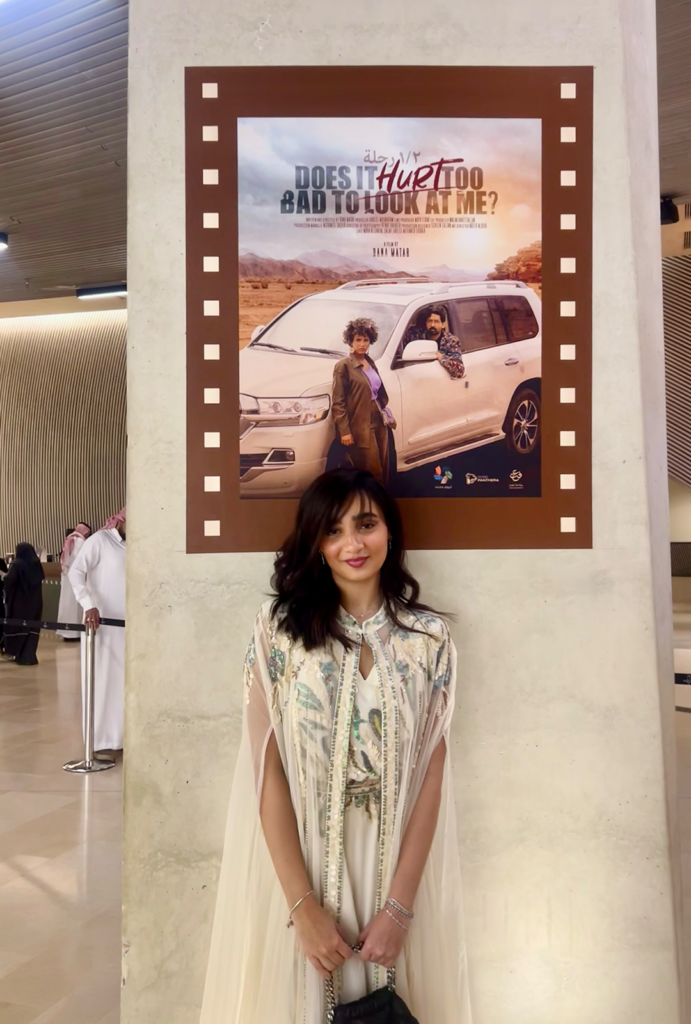
Recognition came quickly: her documentary, “Your Voice Only,” won the Netflix award for Best Documentary at the BFI Future Film Festival and premiered in the Shorts Competition of the 39th Kurzfilm Hamburg Film Festival. Her fictional short film, “Does It Hurt Too Bad to Look at Me?” premiered in the International Competition of the 45th Cairo International Film Festival and screened at the Red Sea International Film Festival, Amman International Film Festival, and the Saudi Film Festival. What’s more, Rana’s original series, “Why, Soad?” was developed at the Royal Film Commission of Jordan’s Series Screenwriters Lab. Beyond just proving herself, Rana found that “it’s a healing process. Every time I write a story, I grow, and I heal completely from it.”
Let’s do a play-by-play of her journey: Rana started by exploring her voice, honing in on the elements of herself that were projected in the stories she told. For example, she has three nationalities – Jordanian, Egyptian, and Algerian – and she says she has “always had this feeling that I wanted to find my identity. Every class in film school you enter, they would revolve around ‘write your story, write your identity, write your culture’ [because] the most authentic stories are the ones from your culture.” Originally, film school was a creative outlet that Rana leveraged to learn about herself, but she came to realize that something bigger was transpiring: “I’m not only telling my story, I’m telling the stories of a lot of women from the Middle East in their early 20s.” For Rana, film is a means of claiming, sharing, and defending the collective narratives of her audience.
The on-screen experience she creates gives “people a lens to different places that only through film they would be able to reach.” She dedicates unyielding determination to each and every project because she’s cloaked in the reassurance that “it’s just the law of energy. Everything you put your heart [into], and you really work hard [at], you’re going to find the results.”
Aiming to build upon the momentum, Rana’s future holds larger projects and bigger aspirations, leveraging the platform she has built – an audience that is listening. As she says, “Being in a room where you are really seen and heard and trusted…this is where you blossom.” Rana unveiled her debut feature documentary at the El Gouna Film Festival and, in the festival’s market, her winning pitch for a feature film has landed her a spot at the Rotterdam Film Festival Director’s Lab where she will move the project further into development. Challenges may await her as they await us all in the pursuit of great strivings, but one thing is for sure: she will face them as one who is telling honest, original, and important stories.
Follow along her journey on Instagram – @rana.w.matar!
Written by Sydney Leclerc