Dahlia Baeshen
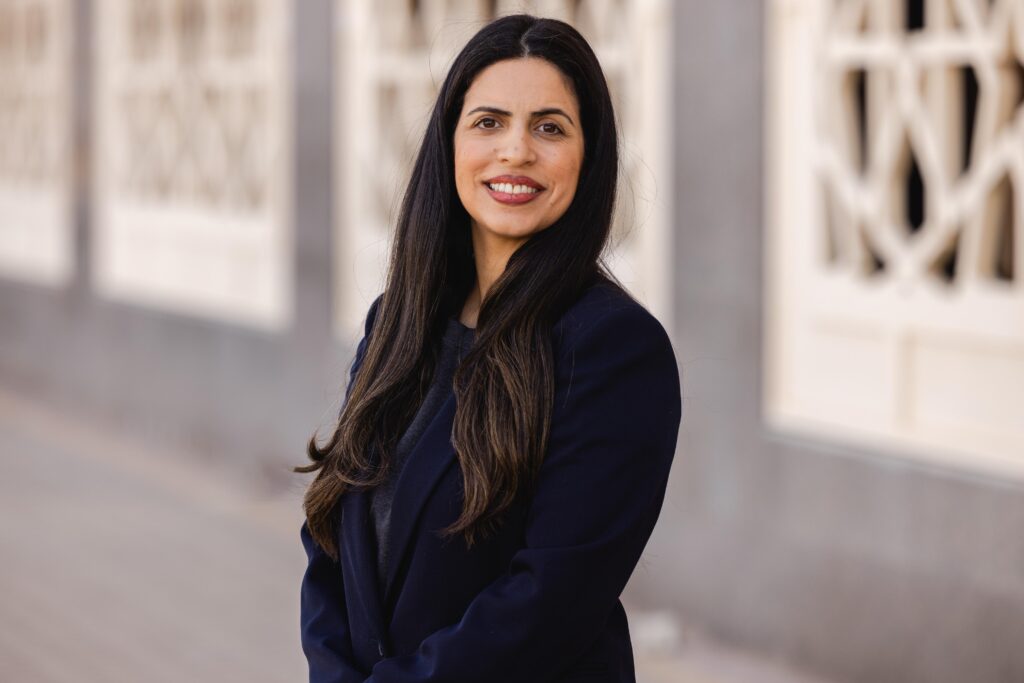
There’s a thirst for knowledge that lives within all of us. Its purpose is to build momentum that pushes us to connect with one another through shared humanity. Commonalities can be discovered between every corner of the world. Film – the marriage of words, environments, sounds, cultures – is one of the most natural ways to extend these bridges. It’s this ideology that drew Dahlia Baeshen, a Jeddah native, into the industry. The now-established screenwriter and producer was once just a girl, in love with the art of storytelling.
She was captivated by the screen; by the trajectories of characters, the way their relationships ebbed and flowed. “I was 11 years old sitting in the living room with my mom,” Dahlia remembers. “I didn’t know the word for a screenwriter at the time, but I was watching Notting Hill, and I told my mother, ‘I want to be that person,’” the one designing the story. She began printing out scripts, reading them line by line, studying the words. The more she learned, the deeper her attraction to film grew. “I was such a big dreamer and delusional enough to think that nothing [was] going to stop me…I [was] going to be a screenwriter. And I never changed my mind,” Dahlia shares.
At 16, she kicked things up a notch. She embarked on a 4-week-long program with the New York Film Academy at Harvard University in Cambridge. They focused on 16-millimeter filmmaking. After high school, she found herself at the American University in Paris studying communication, cinematic theory, and film criticism. Her days were spent delving “into how movies are made in terms of technicality, in terms of feminist theory, in terms of the historical context of what was going on at the time.” She absorbed cinema from different cultures: French, Czech, and Arab. She graduated with her mind opened to the infinite combinations of images and styles, and how techniques can be employed to convey unique feelings.
All of the information she had acquired, though, was lacking a connection; a vessel in which to be shared. “I felt lost coming back from Paris,” Dahlia says. She was yet to find an opening in the industry that supported the long-form storytelling of creative narratives, but rather, the work was centered more around commercials. And with that, she jumped ship: “I took a completely different path. I worked as an employment advisor and thought to myself, ‘Maybe this is just a pipe dream.’ This is when I gave up.” Moments of uncertainty and confusion – they’re shared experiences amongst us all. And, in retrospect, we typically find that the detours we took were leading us where we needed to go.
Even in the midst of an administrative environment, Dahlia’s creative spark never completely burnt out. She looked around the employment office and thought, “This place I’m in is a story. This is something that I want to write about one day…it enriched me more than I thought.”
She went to San Francisco to study creative writing at the California College of the Arts. It accelerated the relationship she had with storytelling. “When I wrote,” she says, “I couldn’t write a Saudi female character. [The people] I saw on screen didn’t reflect me. So, I wrote Italian women, French women, Albanian women, but I could never write anyone who came from my country, from my city. And when I tried, it was a male.” She worked and worked and broke down barriers, exploring herself and her culture. “It took a lot of practice to have the freedom to write.” Now that she’s found a sense of enlightenment, she’s sharing it with her audience.
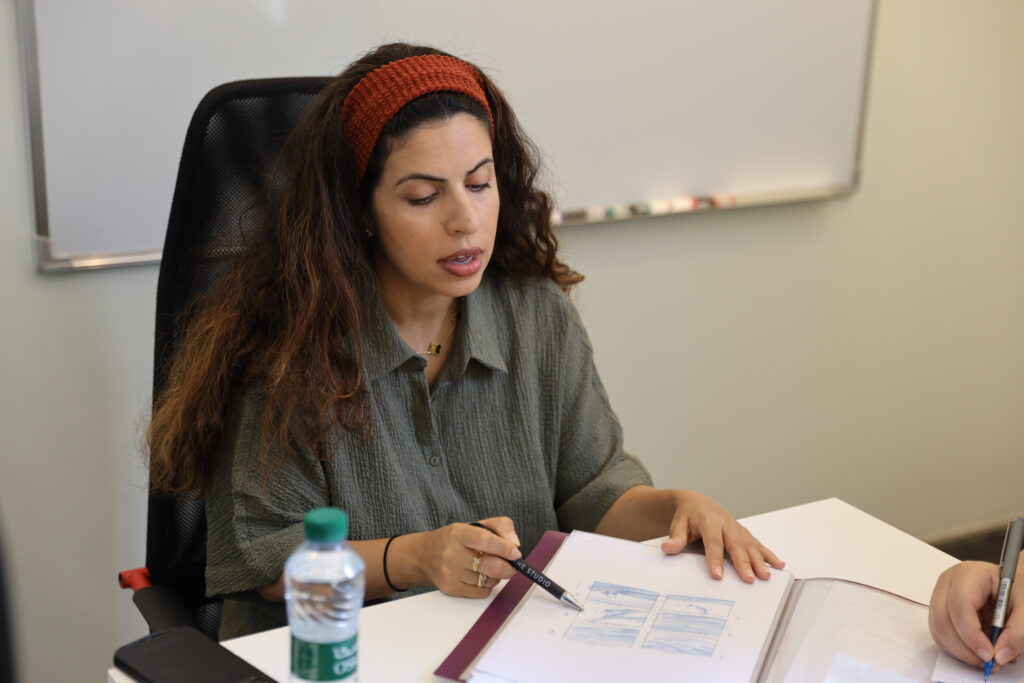
As whimsical as storytelling can be, “There’s something mathematical about screenwriting,” Dahlia explains. “I take the idea I like the most, and I expand it, write it into a synopsis, stay with it, think about it, and from that synopsis I decide to write a treatment…Then I decided to expand it to another 10 pages.” It’s a systematic process. Time-consuming, it takes discipline and grit. The outcome, as worthwhile as it may be, should never neglect the progression that brought it to fruition.
Perhaps more importantly, Dahlia imparts another piece of wisdom that any aspiring filmmaker could apply: “Attend every film event [you] can. You’ll find other people like you who are trying – who want a chance. You never know who will give you [that] chance. And whoever doesn’t – that’s also something to learn from.” The notion of looking out for professional connections in every environment can go far; it did for Dahlia.
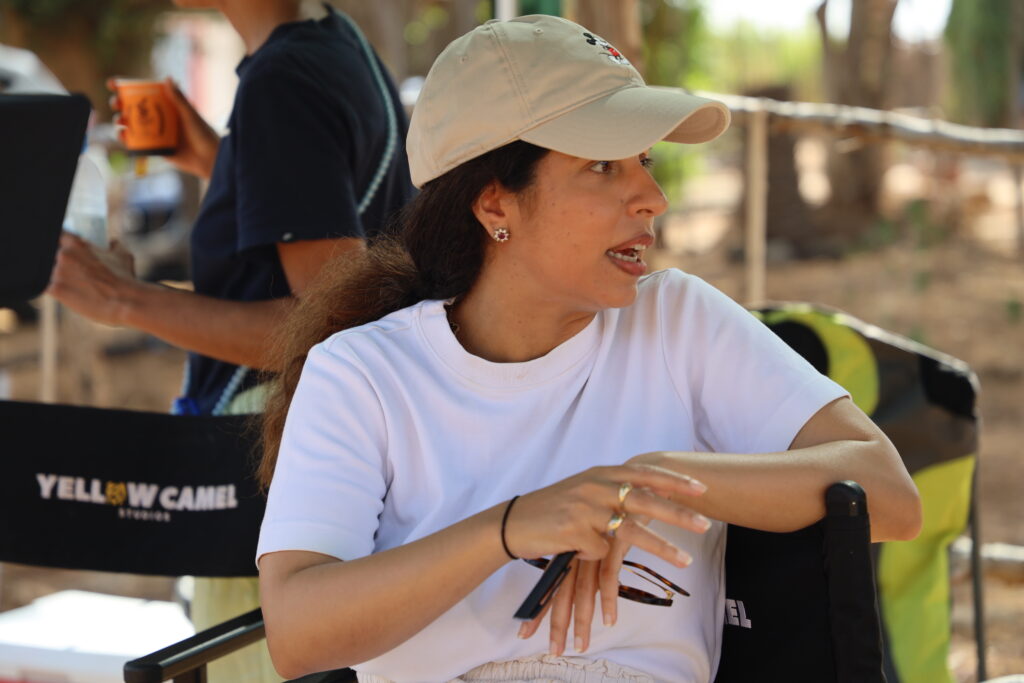
Dahlias’ inherent inclination to understand those around her makes networking come naturally. At a social dinner, she connected with a Portuguese producer. They stayed in touch, and down the road, they created a team that told the story of Floating in the Sand. The film enters the life of a daughter who loses her mother. She navigates the grieving process alongside her father, who has a distinctly different approach to healing. “It was beautiful, with producers from Saudi Arabia and Portugal, and me as a writer/director, the actors were amazing.” The melding of perspectives and expertise made for the perfect pairing.
It all circles back to relationships – to finding common ground between the people we encounter. The yearning for a deeper understanding of one another gives way to opportunity; a chance to dissipate isolation by building community. The more connected we feel to one another, the easier it is to let peaceful creativity flourish. Dahlia’s real-life story, and the ones she displays on screen, are proof.
Follow Dahlia’s journey on instagram: @thewritingame
Written by Sydney Leclerc